Showing posts with label non linear optics laser z-scan SHG. Show all posts

17 July, 2009

Z-Scan: No Sense Suffering in Silence, and Dying in Pain

Okay, so, after talking to my professors, I (with Francis) have cleaned the laser's (PY61C, from Continuum) guts with fresh dichloroethane, put it into free run, made sure the acousto optic modulator was working as it was supposed to, optimized for amplitude inside the laser cavity without the aperture, then with the aperture (though I probably only found the local maximum in both cases, rather than the global maximum -- bummer), then stabilized the laser. I then (with Francis) put in the laser dye (Q-Switch I, from Exciton) at 0.98kV on the oscilator (which is 2 notches above the 0.94kV on the flashlamp for the lasing threshold) and killed the extra longitudinal modes, but we could not see anything on the digital (or analogue) fast osciloscope. So, we increased the oscilator voltage higher, and higher, killing off the new longitudinal modes using more laser dye, until we got the gaussian pulse train (per flash of the laser's flashlamp) to be bright enough to be detected by the electronics of the digital fast osciloscope. We then put more dye until only 8-9 pulses were left in the gaussian pulse train. We then turned down the voltage supplied to the oscilator's flashlamp until we got no lasing, and turned it up again. We found the lasing threshold to be 1.04kV, and we went two notches up, as instructed, and set the oscilator's operating voltage to be 1.08kV. At this point, we still had 8-9 pulses on each pulse train, on our 20Hz Nd:YAG laser system. We then played with the timing of the gate on the Pockel Cell, and got a stable beam dump laser output (energy fluctuation was within plus/minus 10%).

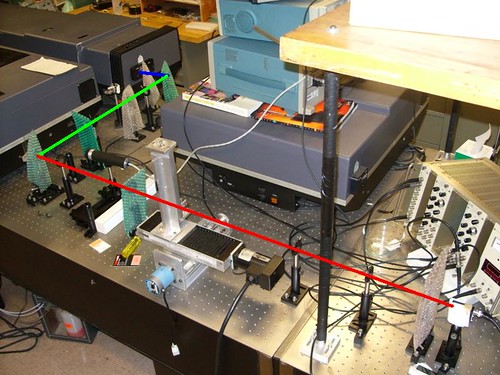
Now, here is the path of the laser:


Z-Path_1
Originally uploaded by faisal_halim


The blue part shows the path of laser after exiting the laser housing (inside which also reside the laser amplifier and the second harmonic generating KDP crystal), the green part shows how the beam is moved to the other end of table, and during this part the laser beam is attenuated to meet the experiment's requirements, and the red leg of the journey shows the part of the beam used not just for taking beam energy readings (see the energy meter's reading head to the top right of the red leg), but also the z-scan readings.

To align the beam the mirror at the blue-green intersection is moved until the beam hits the first aperture on the red leg dead on, and then the mirror at the green-red intersection is moved until the beam hits the second last aperture dead on (we try not to touch the last aperture, as its diameter will effect our scan results).

Now, all the alignment assumes that we have a gaussian shaped circular beam (this is accomplished by tuning the laser cavity properly, and then by carving out any unwanted portions of the beam using the first aperture in the red leg of the beam). If we have a TE01, or a TE10 beam, then we are not to use such a beam. A roughly circular beam may be carved into a more circular beam (if it has a halo of some shape, to one side, then that may be carved out, too), and used in z-scan experiments. At first, we kept getting what looked like a TE01 beam,
(see: My z-scan is still misbehaving)
but it turned out that that problem was caused by a faulty polarizing filter (in the green leg), which I promptly removed.

The problem that we are facing, right now, is that while our beam looks circular, it also looks like most of the energy is concentrated along a crescent along one edge of the beam -- kind of like when you can see a crescent moon, at night, but can see a halo like glow that betrays the existence of the whole of the moon's disk, though, I exaggerate. So, no matter how well we align the beam, I simply do not think that we will get a z-scan (and, right now, we are not getting a z-scan). So, while I am not sure what exactly I should do, I am thinking that I should go back to the laser, optimize the laser cavity (finding the global maximum of the peak beam intensity, for all the possible back mirror positions), then put in the aperture, and then scan through all the possible positions to find that global maximum for the photon content of the cavity, and then, hopefully, I will have a beautiful, gaussian, laser beam.

Another, perhaps crazy, idea that I am having is finding another aperture (smaller than the one we are using inside our laser cavity), and taping it over the current one -- or, maybe, I can talk my professors into buying a smaller aperture, at a later time.

I am sure that my problem with the notorious crescent is not something new in the field of z-scans -- the technique has been around for a while, now, so I am sure I am not the first person to encounter this problem. While I have not found any blogs, or stories, by anyone who has solved this problem, I am hoping that when I am done with this issue my story will benefit those who have this problem after me. No sense suffering in silence (keeping the world in the dark), and dying in pain (perishing, by failing to publish)-- there is no sense in playing the MIBs (or anyone who gets in, gets the job done, and leaves without a trace, with no one knowing that he/she was even there) from the Will Smith/Tommy Lee Jones movie Men in Black. Afterall, as a scientist, you are really a part a whole much larger than yourself, and your own private dreams. As an engineer, or a scientist, you have the rest of your team, or community, actually depending on you, rather than just waiting for the job to get done, without a care for you (yeah Ejovi Nuwere, author of Hacker Cracker, is a real inspiration). It makes much more sense to be heard, and helped, if only to help someone else.

12 July, 2009

Z-Scan: My z-scan is still misbehaving.

My z-scan is still misbehaving. I have been given a deadline of Monday morning (13th July, 2009) to submit the results of the z-scans that I have been asked to do. Each time I think I have made progress, however, it turns out that I have left something out. One time, I forgot one of the system checks, another time I forgot to put a lens back, another time I had trouble realigning for a different wavelength. So many challenges, trials, and tribulations. O well, more later. Work now.

  • Just so you know, a z-scan is an extremely elegant optics technique, used for measuring two photon absorption (take that, my high school physics teacher!) and intensity dependent refractive index change of materials.
I am back, for a few minutes. You see, this is the second week running that I am doing this experiment, and it turns out that I had had quite a few of the fundamentals of a mode-locked Nd:YAG laser misconceptualized. I had thought that in order to get such a laser working (ours is a dye laser) you have to set up the oscillator (the back mirror, the beam path length altering prism, the acousto-optic modulator, and the aperture need to be properly set), pump it with the appropriate level of power, then put in the q-switch dye, and then adjust the back mirror and prism while the laser's Pockel Cell was turned on. O, how I was wrong! If you try to get a stable reading for the energy scattered from the laser while the Pockel Cell is in action, then your experiment will be in a state of inaction, and you will be in a tensed state of hyperactivity; which is why I spent 36 hours to take a few z-scans last November.


As it turns out, you first get the laser to start lasing at its threshold (or higher, depending on your needs), align the optics, then increase the laser oscillator's flashlamp voltage (we have a Continuum PY61C laser) by two notches. You then kill all the transverse modes, using the laser dye, and use the back mirror and prim (adjust their orientation and position, respectively) to stabilize the amount of light being scattered (you can observe this on a slow scope, or even on a fast one). You then turn on the Pockel Cell, and change its triggering photodiode's sensitivity, the cell's gate timing, and the orientation of the in cavity half wave plate to dump a fixed portion of the Gaussian pulse train in each pulse of the 20Hz laser. Using this two step approach we get a very stable output from the laser. Well, guess what, my buddy and I (both of us have been working on z-scans for some time, now) finally grasped that only last week. In case you are curious, to the left is what our laser looks like.


Of course, that was not the end of our troubles: my partner in crime (Francis) and I (hey, don't look funny, holding up the experiments does feel criminal, no matter how inadvertent) still had to learn the proper, practical way to move a laser beam. This picture shows the optics:


The laser beam that comes out of the laser housing has to be reflected by a series of two mirrors, so as to shift the height of the laser beam, while making sure it goes parallel to the surface of the optical table, even if the beam was not parallel to this surface when it exited the laser housing. For this, the simple (and naive) rule is that you use the mirror close to the laser housing to align the beam onto the center of an aperture held just after the second mirror, and then use the second mirror to align the beam onto the center of the aperture that will be closed if you are doing a closed aperture, intensity dependent index of refraction experiment. Of course, we know that when one mirror is moved, then fine changes have to be made to the other, so I use both the mirrors to align to the center of the first aperture, and then I use both the mirrors (sequentially, again) to center the beam onto the second aperture. I feel that we do a more effective job, this way.

_____________________________________

Okay, the fire alarm is going off: Sunday's annoying tests.


That means I cannot run z-scans for the next half hour, oso (or, maybe, an hour). I can check on the laser's stability, during this time. So, let me show you what I have done in the meantime. Since before last night, Francis and I noticed that our beam profile looked like this:


Now, I spent the whole of last night trying to get a TEM00 beam, but in vain. So, I decided to turn the laser green (using second harmonic generation), then align the optics so that one of the lobes gets cut off by the aperture, while the other is used to approximate a TEM00 beam for the z-scan:


Of course, that fire alarm went off before I could verify that what I was doing would give us good z-scan results -- that flashing fire alarm could throw off my readings.

The idea is that if I can get away with doing the experiment this way with green light, then I can also do the same with infrared light. Now, let's just hope that this works!

________________________________________

AAAAAAAAAAHHHHHHHHHH!!!!!!!!!!!!!!


In the past half hour, my laser's output power has consistently drifted down! No wonder my z-scans are coming out bad.

________________________________________
It's Monday, the 13th of July, 2009, now. The laser has been VERY stable, and I have successfully used single lobe of a deformed TE01 mode to do a reasonably good z-scan of CS2 at 532 nm, at 4 uJ. I have also taken an okay z-scan of CS2 at 1064 nm at 14.3 uJ. I kind of looked funny, perched in a precarious looking position (though it was very stable), when I was alighing the optics to get the laser beam centered on the aperture:


(Kids, do not align a laser the way you see me doing it here: it is very, very wrong! It is a little too dangerous for the eyes.)

Taking z-scans at lesser energies has been the major hurdle:
  • The beam has a lower power, and it needs a certain radius, below which the the beam is so tight, that most of it passes through the aperture during the closed aperture z-scan
  • The boxcar is taking very noisy readings, eventhough the laser is very stable -- I ahve noticed a lot of noise on the lines conneting the instruments.
Right now, the system is a little overworked, so I am letting it cool off. I shall hope to have z-scans of samples before my professors walk into the building, in the morning. I am also going to need some coffee. During the last cooling period (when the laser had heated up) I took to some entertainment:


I shall hope to get readings, and analyses, to my professors, this morning.


_____________________________________________

Okay, I was unable to deliver. My prof. says that carving out a portion of the lobe of a TE01 for a gaussian is not the solution, so I have to set up the laser, again, from scratch. Interesting that I was able to get nice looking z-scan curves for CS2, though.